Orson Scott Card is in hot water over his outspoken homophobic views on gay marriage, and Geeks OUT (Why is "OUT" capitalized?) want to boycott the film adaptation of his novel, "Ender's Game." Which is surprising, because his novel is incredibly gay. Not just gay as in it's basically Harry Potter in space, (it is), but gay as in there's a huge level of homo-eroticism in the novel (about children).
The aliens in the book are called, "Buggers," because they're bugs. "Buggery," though, is the act of sodomy, which is super-sweet. From that correlation I'm not certain if we're supposed to think that the Buggers are a metaphor for homosexuals. The entire plot to the novel is that Ender has to kill all the, "Buggers," and Orson Scott Card is a homophobe. So I'm guessing, "Yes."
For a supposedly heterosexual boy, Ender gets into a lot of gay situations. In one scene, there's a fight in a shower room with some sweaty, naked boys, which you'll recognize as being gayer than anything ever shown on, "Glee." Ender murders the boy who started the altercation (while naked) by kicking him above the dick, which still fits into the whole anti-gay thing. Audiences can look forward to seeing that cut or altered from the film because the film-makers don't want to be arrested.
There's also the "bromance" between Ender and Bean, (Ender's the top and Bean's the bottom). Bean idolizes Ender, but Ender uses him. Ender also gets up to some gay shit with his brother and there's a scene where Peter sits atop Ender and threatens him with his crotch near his face (Peter's a top too).
There's also a scene reminiscent of the South Park episode where Lemmingwinks the gerbil crawls inside Mr.Slave's ass. It's actually a mouse eating it's way through a giant's eye, but I'm certain he would have gone into the ass if that option was available.
Friday, July 19, 2013


Wednesday, July 17, 2013
One Flew Over the Cuckoo's Calling
It was recently revealed that J.K. Rowlings had written a novel under the pseudonym "Robert Galbraith," entitled, "The Cuckoo's Calling." After four months, the novel had only sold 1,500 copies, which could be considered respectable for a first time author named "Robert Galbraith," but it wouldn't exactly pay to keep the lights on. Since it was revealed that Robert Galbraith didn't exist, but was instead the famed author of Harry Potter, the novel has gone on to sell 100,000 times that amount. In a nutshell, this is what's wrong with the literary world.An author can write a novel that can garner critical acclaim and it can collect dust on the shelves. If that same author happens to be famous, that same novel will sell millions.
What causes this difference? You, the reader.
I've written numerous blogs about the roadblocks preventing a person from making it to print. To publish a work based on it's own merit is virtually impossible in this day and age. Even after making it to the shelves, there's no guarantee anyone will read your work. Worse still is the inability to independently publish an e-book and have it read, even if you offer it for free. Word of mouth, traffic and advertising are huge factors in being noticed in an Ocean with too many fish. "Robert Galbraith" could have written the best thing ever and still no one would take notice. As it stood, with sales the way there were, there would have been no justification to continue with a sequel to the novel until Rowlings let it slip that she was the author.
You can understand why a famous writer might use a pseudonym. There's too much pressure from fans and publishers alike to regurgitate what you've already written.There's also the fear of failure and criticism. In Rowlings case it looked as if she wanted to see if she could make it on her own. The answer she got was, "Kinda." If she'd been starting out as, "Robert Galbraith," she could have looked forward to years of painstaking work trying to inch up a ladder that shouldn't exist in the first place. It'd be like starting out in the mailroom of a company and trying to work your way up to C.E.O.. If all of this had been legit, the unsold copies of the book would have returned to the publisher in a few months, and "Robert" would have to do some serious convincing to get his next work published. After all, 1,500 copies or so at $12.99 apiece is only about $20,000. There's no telling what "Robert's" percentage of that would be, but he'd have to keep his day job for certain. As time goes by, he's less likely to sell more copies as bookstores keep their stock for only so long.
Saturday, July 13, 2013
The Worst Things in Cartoons
Cartoons are easy-to-absorb and have instant appeal but can maintain the complexities of heavier drama hidden inside their framework. That doesn't stop them from trying to force the personal high-brow interests of the creators onto an audiences that came to kill some brain cells. Some of the most popular cartoons ever made are filled to bursting with themes that no fan has asked for, but can be found in most episodes. For instance:
Looney Tunes and Opera:

It's practically right there in the title, but "Looney Tunes" is rampant with classical music. It's extremely likely, as "Seinfeld" pointed out, that most people are familiar with opera simply because of "Looney Tunes." There were cartoons devoted to works such as, "The Barber of Seville," and "The Valkyire," among others. It was a complete mish-mash of the highest and lowest forms of culture in cartoons intended for slack-jawed children. "Looney Tunes" has probably done more to class up youth culture than public schools. The question remains, "Why?" It's not as if these works were ripe with comedy, but somehow they all end up being about a cross-dressing rabbit and a bald man who wants to kill him.
Family Guy and Big Band music:

Because of creator Seth Green's obsession with Big Bands like the Rat Pack and his eagerness to showcase a singing voice that later landed him a gig hosting the Oscars, there's numerous musical interludes in many episodes of "Family Guy." Obscure references like, "Shipoopi" have ground entire episodes to a stop.This is all inside the context of a show about a farting fat man and a megalomaniac baby. It adds a touch of class to a show that is famous for having no class. Additionally, these musical interludes are the least recognizable references to the audience that is already struggling to "get" all the references.
The Simpsons and Jazz:

Do you like Jazz? No. No one does.If anyone tells you they do, they're lying hipsters trying to get in your pants. Yet, every single episode of, "The Simpsons," contains at least one reference, usually in the opening credits when Lisa plays her sax. Then there's entire episodes dedicated to Lisa and Jazz, which somehow end up being the most depressing episodes in their 20 plus year run. I'm confused as to whether or not there is even a cross-over with audiences that like, "The Simpsons," and Jazz. That has to be a pretty small niche, known as the, "Dennis Miller Ratio."
"The Simpsons" even burns the musical genre of Jazz in one episode with the lines, "You have to listen to the notes they're not playing."
"I can do that at home."
G.I. Joe/He-Man/Transformers, etc. and PSAs:

Every 80's cartoon that mattered ended with a brief interlude that broke the fourth wall and gave audiences some practical advice, because the assumption was that schools and parents weren't as effective as raising kids as Optimus Prime. I have no idea how they picked which pressing issues to address. I'm assuming some Reagan-Era think tank pulled ideas out of a hat, or more likely their asses. If you want to know how well this advice holds up today, look at the meth-addicted world spiraling into a never-ending nightmare of debt, terrorism, pollution and fear-mongering. I can't recall a single time when I ran into a problem and thought, "What did Shipwreck tell me to do?" The worst offender, by far, was the mega-crossover special involving TMNT, Alf, Bugs Bunny, The Real Ghost Busters, Alvin and the Chipmunks and so many, many, many more.

It was a total cluster-fuck of every cartoon character you've ever loved in the 80's doing something terrible. That "terrible" was getting kids to say, "No," to drugs. That didn't work. In fact, the whole episode was like a Dave Chappelle sketch explaining to you exactly how awesome drugs could be by simulating the effects, because if you ever see Winnie the Pooh and the Smurfs at the same time in a show, you're probably high as fuck.
Peanuts, Futurama, Bambi, etc. and Sadness


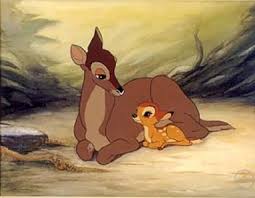

Most people don't watch cartoons to be fucking depressed. As a medium, cartoons can have the same emotional impact as any other artistic work. That doesn't mean that should try and cover the full spectrum of human emotion. The worst part is how audiences get lured in with the common fare and then hit in the stomach. "Bambi," is a movie about a baby deer frolicking in the forest up until the moment his mother gets shot.There's a complete and total contrast that isn't supposed to exist. It's cheap tactics and it works, usually because the audience is seven-years-old and hasn't fully fathomed that death lurks around every corner and it's waiting for their loves ones.
Looney Tunes and Opera:
It's practically right there in the title, but "Looney Tunes" is rampant with classical music. It's extremely likely, as "Seinfeld" pointed out, that most people are familiar with opera simply because of "Looney Tunes." There were cartoons devoted to works such as, "The Barber of Seville," and "The Valkyire," among others. It was a complete mish-mash of the highest and lowest forms of culture in cartoons intended for slack-jawed children. "Looney Tunes" has probably done more to class up youth culture than public schools. The question remains, "Why?" It's not as if these works were ripe with comedy, but somehow they all end up being about a cross-dressing rabbit and a bald man who wants to kill him.
Family Guy and Big Band music:
Because of creator Seth Green's obsession with Big Bands like the Rat Pack and his eagerness to showcase a singing voice that later landed him a gig hosting the Oscars, there's numerous musical interludes in many episodes of "Family Guy." Obscure references like, "Shipoopi" have ground entire episodes to a stop.This is all inside the context of a show about a farting fat man and a megalomaniac baby. It adds a touch of class to a show that is famous for having no class. Additionally, these musical interludes are the least recognizable references to the audience that is already struggling to "get" all the references.
The Simpsons and Jazz:
Do you like Jazz? No. No one does.If anyone tells you they do, they're lying hipsters trying to get in your pants. Yet, every single episode of, "The Simpsons," contains at least one reference, usually in the opening credits when Lisa plays her sax. Then there's entire episodes dedicated to Lisa and Jazz, which somehow end up being the most depressing episodes in their 20 plus year run. I'm confused as to whether or not there is even a cross-over with audiences that like, "The Simpsons," and Jazz. That has to be a pretty small niche, known as the, "Dennis Miller Ratio."
"The Simpsons" even burns the musical genre of Jazz in one episode with the lines, "You have to listen to the notes they're not playing."
"I can do that at home."
G.I. Joe/He-Man/Transformers, etc. and PSAs:
Every 80's cartoon that mattered ended with a brief interlude that broke the fourth wall and gave audiences some practical advice, because the assumption was that schools and parents weren't as effective as raising kids as Optimus Prime. I have no idea how they picked which pressing issues to address. I'm assuming some Reagan-Era think tank pulled ideas out of a hat, or more likely their asses. If you want to know how well this advice holds up today, look at the meth-addicted world spiraling into a never-ending nightmare of debt, terrorism, pollution and fear-mongering. I can't recall a single time when I ran into a problem and thought, "What did Shipwreck tell me to do?" The worst offender, by far, was the mega-crossover special involving TMNT, Alf, Bugs Bunny, The Real Ghost Busters, Alvin and the Chipmunks and so many, many, many more.
It was a total cluster-fuck of every cartoon character you've ever loved in the 80's doing something terrible. That "terrible" was getting kids to say, "No," to drugs. That didn't work. In fact, the whole episode was like a Dave Chappelle sketch explaining to you exactly how awesome drugs could be by simulating the effects, because if you ever see Winnie the Pooh and the Smurfs at the same time in a show, you're probably high as fuck.
Peanuts, Futurama, Bambi, etc. and Sadness
Most people don't watch cartoons to be fucking depressed. As a medium, cartoons can have the same emotional impact as any other artistic work. That doesn't mean that should try and cover the full spectrum of human emotion. The worst part is how audiences get lured in with the common fare and then hit in the stomach. "Bambi," is a movie about a baby deer frolicking in the forest up until the moment his mother gets shot.There's a complete and total contrast that isn't supposed to exist. It's cheap tactics and it works, usually because the audience is seven-years-old and hasn't fully fathomed that death lurks around every corner and it's waiting for their loves ones.
Monday, July 8, 2013
In Da News
I don't understand "media" sometime. Earlier this week, police foiled a suspected terrorist plot that was targeted against Canada Day revelers at the BC Legislature in Victoria. It was kind of a deal, even though nothing about the story made sense. It was supposed to have been a radicalized Islamic terrorist plot thought out by a porcelain white, drug addict and paintball enthusiast with mental issues and his drug-addicted prostitute girlfriend (saying "drug addicted" is redundant when the suspects are from Surrey). They were trying to emulate the Boston Marathon massacre, and if successful, dozens of lives could have been lost and hundreds more could have been injured. It would have been the worst act of terrorism on Canadian soil, making it our "9/11."
Barely a week later, and the same paper that broke the story is writing articles about a strip club using the phrase, "fresh meat," in their advertising. There's no trace of the story except for in the editorial page. Even on huffingtonpost.com you have to scroll down twice to find a mention of it, especially after the train explosion in Qubec.
Is it not newsworthy? Did they shoot their whole load at the starting gate and now there's nothing left to do but editorialize? If you were on vacation for about three days you'd never know it happened. Seriously, the story is FUCKED UP. Basically, the living stereotype for a Surrey resident went batshit crazy, converted to Islam, and tried to kill a bunch of people INDEPENDENTLY. All sources say that he didn't seem to have the wherewithall to pull off something like this, since he's a crazy drug-addict, and suspect he might have had help from outside sources, but there's no evidence of it. That means he managed it all on his own, despite all reason, which is somehow even scarier than if he had factual terrorist connections. With "real" terrorists, they have networks and link government agents can follow. If someone up and decides they're going to martyr themselves all on their lonesome, that's scary.
Saturday, July 6, 2013
In Zod We Trust
I want to talk about how "Man of Steel," is the worst "Superman" movie. Not the WORST Superman movie, but the worst, "Superman" movie. If you're ranking them on their individual merit, it's probably the third best in the franchise, but in terms of portraying "Superman," it's the worst. Even worse than "Superman IV: The Quest for Peace," the one where they didn't bother to airbrush out the wires and they let Christopher Reeve do whatever he wanted, and the plot was about Superman throwing all the nukes into the sun and accidentally creating a nuclear superhuman.
"Man of Steel" is far grittier than any other Superman movie, since that's now a requirement for all reboots. Most of that grit got on the character himself, who kind of goes off the rails. He starts off bumming around Earth taking odd jobs and changing his identity every few miles. He has a "turn the other cheek" policy when it comes to confrontation, but like a psychopath he uses his powers to impale a semi-truck on logs when a guy at a bar throws a drink at him. Somehow, one of his superpowers is forging the necessary documents to apply to any job he wants, because he ends up working at an military controlled Arctic station. You'd think the army would at least run a background check on a guy who doesn't even have a picture ID before letting him in. How does he even get paid without a Social Insurance Number? Assumingly, he's doing all this to find out more about his origin, which he knows comes from another planet. So what was his plan? To just keep wandering around forever and magically find a trace of an alien race? Why didn't he become an astronomer?
Amazingly, it works. He finds a stranded Kryptonian vessel that's been frozen in the ice for over 20,000 years. He finds out his father left him a virtual simulation of himself in a crystal he's been carrying with him all his adult life, which should logically have been completely useless as the odds of him ever encountering a Kryptonian computer interface were literally astronomical. Why did his father even bother with it? He couldn't have planned it out ahead. The vessel, for an even more inexplicable reason, has an El family uniform in it. We find out the, "S" stands for, "Hope," but it's also the symbol for the house of El. So really, it means, "El." He's Elman, or possibly Hopeman. His real name is Kal-Hope.
His father, by the way, is the worst criminal in Krypton's history. He steals the very means the Kryptonians have to reproduce.That's like sterilizing every man, woman and child on the planet all at once. He's even told before he does it that it's a "Zeta-Level" crime, which one would assume means "Way-Bad."
If that's the case, then why isn't his wife, who's his co-conspirator, arrested? She's at Zod's trial, standing with the rest of the high council. She's also guilty of breaking their strict "no-child" policy. Why is there a double-standard?
If the movie had been directed a little better, audiences could have walked away wondering if Zod had been the hero all along, instead of a fascist maniac.He's basically just Super-Hitler, but he's just the product of his people. He was literally made to act that way. Superman has a choice, and he chooses to kill the last surviving embryos of his people. He aborts an entire species while the "bad guy" begs him to show mercy. How cold is that? There wasn't even a reason to. He'd already destroyed the World Engine. All that was left was to mop up some leftover Kryptonians, and he could have called it a day. He makes a choice to kill his own people while they're still in the womb. He decided to kill a species based on a day-long encounter with a single group of people. That's like deciding to kill all Aryans because you didn't like the Nazis.
It's the single, most evil thing I've ever seen anyone do in a movie. That's why I don't think it's even a Superman movie. He never calls himself Superman, after all, it just kind of crops up as a nick-name.
I think he's actually Ultraman, the evil-opposite version of Superman from Earth-3.

Ultraman's real identity is Clark Kent, but he has a different origin than Superman. His powers are the same, but Kryptonite gives him new powers. He's also bat-shit crazy-evil. Except for the "U" his costume is closer to the one in Man of Steel than Superman's traditional outfit (no red shorts).
"Man of Steel" is far grittier than any other Superman movie, since that's now a requirement for all reboots. Most of that grit got on the character himself, who kind of goes off the rails. He starts off bumming around Earth taking odd jobs and changing his identity every few miles. He has a "turn the other cheek" policy when it comes to confrontation, but like a psychopath he uses his powers to impale a semi-truck on logs when a guy at a bar throws a drink at him. Somehow, one of his superpowers is forging the necessary documents to apply to any job he wants, because he ends up working at an military controlled Arctic station. You'd think the army would at least run a background check on a guy who doesn't even have a picture ID before letting him in. How does he even get paid without a Social Insurance Number? Assumingly, he's doing all this to find out more about his origin, which he knows comes from another planet. So what was his plan? To just keep wandering around forever and magically find a trace of an alien race? Why didn't he become an astronomer?
Amazingly, it works. He finds a stranded Kryptonian vessel that's been frozen in the ice for over 20,000 years. He finds out his father left him a virtual simulation of himself in a crystal he's been carrying with him all his adult life, which should logically have been completely useless as the odds of him ever encountering a Kryptonian computer interface were literally astronomical. Why did his father even bother with it? He couldn't have planned it out ahead. The vessel, for an even more inexplicable reason, has an El family uniform in it. We find out the, "S" stands for, "Hope," but it's also the symbol for the house of El. So really, it means, "El." He's Elman, or possibly Hopeman. His real name is Kal-Hope.
His father, by the way, is the worst criminal in Krypton's history. He steals the very means the Kryptonians have to reproduce.That's like sterilizing every man, woman and child on the planet all at once. He's even told before he does it that it's a "Zeta-Level" crime, which one would assume means "Way-Bad."
If that's the case, then why isn't his wife, who's his co-conspirator, arrested? She's at Zod's trial, standing with the rest of the high council. She's also guilty of breaking their strict "no-child" policy. Why is there a double-standard?
If the movie had been directed a little better, audiences could have walked away wondering if Zod had been the hero all along, instead of a fascist maniac.He's basically just Super-Hitler, but he's just the product of his people. He was literally made to act that way. Superman has a choice, and he chooses to kill the last surviving embryos of his people. He aborts an entire species while the "bad guy" begs him to show mercy. How cold is that? There wasn't even a reason to. He'd already destroyed the World Engine. All that was left was to mop up some leftover Kryptonians, and he could have called it a day. He makes a choice to kill his own people while they're still in the womb. He decided to kill a species based on a day-long encounter with a single group of people. That's like deciding to kill all Aryans because you didn't like the Nazis.
It's the single, most evil thing I've ever seen anyone do in a movie. That's why I don't think it's even a Superman movie. He never calls himself Superman, after all, it just kind of crops up as a nick-name.
I think he's actually Ultraman, the evil-opposite version of Superman from Earth-3.
Ultraman's real identity is Clark Kent, but he has a different origin than Superman. His powers are the same, but Kryptonite gives him new powers. He's also bat-shit crazy-evil. Except for the "U" his costume is closer to the one in Man of Steel than Superman's traditional outfit (no red shorts).
Far Cry 3
Amazingly, I played Far Cry 3: Blood Dragon before playing Far Cry 3. The mechanics, the interface and the gameplay are all essentially the same, as many have called Blood Dragon a Mod or a stand-alone expansion of Far Cry 3. Blood Dragon was also the first game I played in the series.
The recent sale Xbox Live has on some of last year's best games is giving me time to catch up.Far Cry 3 was the game I was most interested in.
I didn't know what to expect going in except for the jungle and the guy on the box art. Vaas comes across as one of the most detailed villains ever to appear in a video game. In so many other games the villain has simply been someone to overcome, but Far Cry lets you try to understand him That being said, he's just a guy with a gun. The protagonist escapes his clutches and goes on a journey of revenge while trying to rescue his remaining friends from Vaas. Along the way, he gains new skills and becomes more adept at killing his enemies. Between the protagonist and antagonist first meeting and their second encounter, Jason manages to kill countless armed combatants as well as hunting down most of the wildlife on the islands. Still, everyone around him drones on endlessly about how Jason still has to become a stronger warrior to ever hope to defeat Vaas. He's given quest after quest that tests his might and makes him virtually super-human. Vaas, meanwhile, is just a dude with an ordinary handgun and no body armor. One single bullet will kill him.It's not like his Kefka, or Gannon. You don't need a mystical sword to kill him.
The hero, while evolving from a whiny and helpless white kid into a "warrior," remains an idiot. Upon meeting an imbedded undecover CIA agent, he immediately tells everyone that he's a secret agent, effectively blowing his cover. That sort of thing is treason back home. He also will take any drug and substance he finds or is given, without knowing what possible effects it might have. Ever the worst meth addicts would likely ask some question. He also insists that every friend he rescues shack up with a guy running a drug lab who also happens to be a heavy user, even though he knows a safe village.
He also sounds like he's falling asleep at any given moment, even when blowing up entire villages. Dude's hard to impress.
Monday, July 1, 2013
Man of Spoilers
By the end of, "Man of Steel," it's revealed that Superman's biological father, Jor-El, embedded the Kryptonian Codex in his son's cells. That means he's the living library of their entire genetic heritage. It's also revealed that the Codex could still be deciphered if Superman were deceased. At the beginning of the movie, Jor-El steals the Codex, which is in the form of a skull fragment with writing on it.
That means that potentially, at some point, Superman could have traveled into the past and died, leaving behind a piece of his skull, which is then used to populate Krypton and birth his own descendants, including himself in a circular pattern.
Also, this is Cyborg Superman:

Notice how he's missing a part of his skull.
While the movie illustrates how Superman gained control of his powers, at no point does it reveal how he knows to fight. In fact, the movie goes to great lengths to teach us how Superman never stood up for himself until the moment he has to fight the Kryptonian soldiers, who have the same powers he does, but with decades of combat experience. How does he manage to hold his own against them if he's never thrown a punch?

In the comic books and cartoons, an adolescent Superman goes into the future to help the Legion of Superheroes and train. Upon returning home to Kansas, he has his memories wiped clean. Meaning he's already traveled through time and will do so again in the future.
That means that potentially, at some point, Superman could have traveled into the past and died, leaving behind a piece of his skull, which is then used to populate Krypton and birth his own descendants, including himself in a circular pattern.
Also, this is Cyborg Superman:
Notice how he's missing a part of his skull.
While the movie illustrates how Superman gained control of his powers, at no point does it reveal how he knows to fight. In fact, the movie goes to great lengths to teach us how Superman never stood up for himself until the moment he has to fight the Kryptonian soldiers, who have the same powers he does, but with decades of combat experience. How does he manage to hold his own against them if he's never thrown a punch?
In the comic books and cartoons, an adolescent Superman goes into the future to help the Legion of Superheroes and train. Upon returning home to Kansas, he has his memories wiped clean. Meaning he's already traveled through time and will do so again in the future.
Subscribe to:
Posts (Atom)